
 admin
When evaluating a changing mole, a chronic rash, or persistent acne, the clinician diagnosing these issues operates within a specialized branch of medicine—yet a dermatologist is first and foremost trained as a licensed medical physician. In the United States, complete dermatologist schooling demands at least 12 years of post-secondary education and clinical training following high school graduation. This pathway comprises four years of undergraduate study, four years of accredited medical school, a mandatory one-year clinical internship, and three years of specialized dermatology residency.
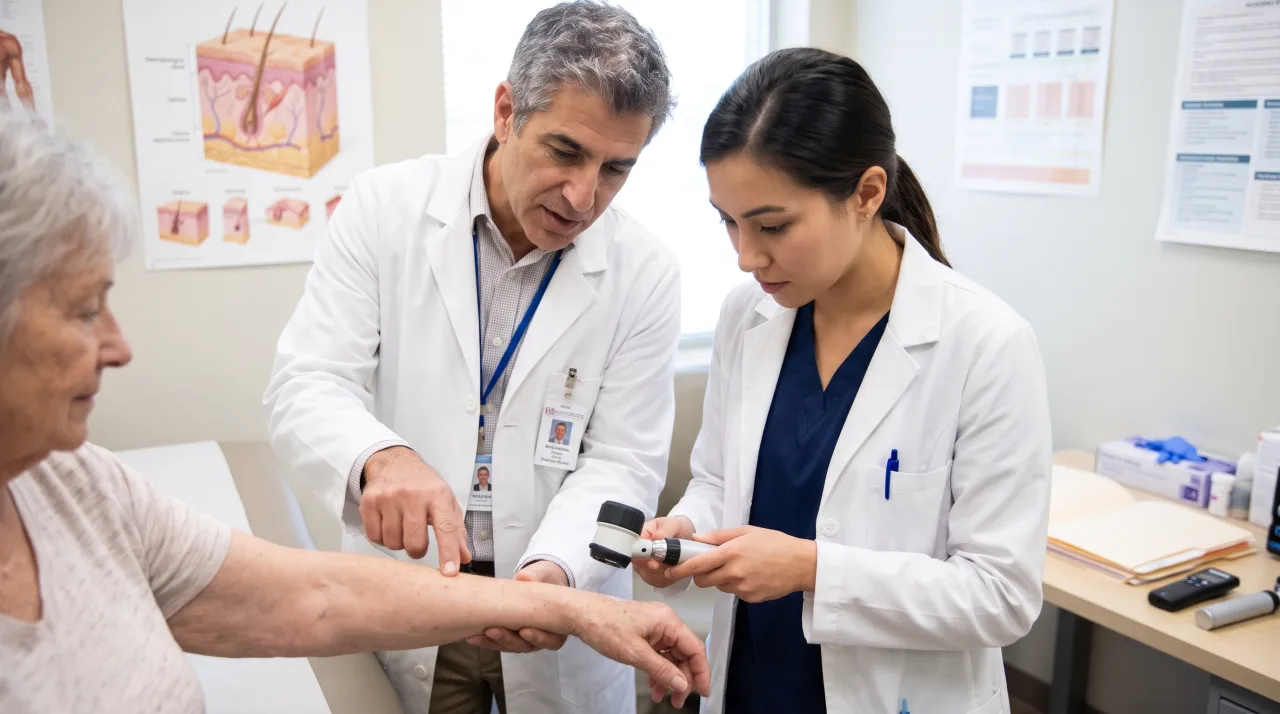
For physicians seeking subspecialty mastery through fellowship programs, the educational timeline readily extends to 13 years or more. Understanding the exact sequence of this demanding career helps prospective medical students plan realistically for each milestone.
The Dermatologist Training Timeline at a Glance
| Stage | Duration | Primary Focus | Key Credentials / Milestones |
| 1. Undergraduate College | 4 Years | Premedical coursework, laboratory sciences, extracurricular clinical exposure | Bachelor’s Degree (B.S. or B.A.), MCAT Exam |
| 2. Medical School | 4 Years | Preclinical human pathology, physiology, and hospital clinical rotations | Doctor of Medicine (MD) or Doctor of Osteopathic Medicine (DO), USMLE/COMLEX Steps |
| 3. Clinical Internship (PGY-1) | 1 Year | Broad rotational medicine (Internal Medicine, General Surgery, or Transitional) | Post-Graduate Year One completion, Medical Licensure eligibility |
| 4. Dermatology Residency (PGY 2–4) | 3 Years | Advanced medical dermatology, dermatopathology, procedural surgery, oncology | Residency Completion, Specialty Board Certification Eligibility |
| 5. Subspecialty Fellowship (Optional) | 1 Year | Hyper-specialized practice (Mohs Surgery, Pediatric Dermatology, Dermatopathology) | Subspecialty Board Certification / CAQ |
Note: The 12-year baseline may expand if students complete gap years, dedicated laboratory research fellowships, or dual degrees (such as MD/PhD or MD/MPH).
Step 1: Earning an Undergraduate Degree
The journey begins with an accredited four-year bachelor’s degree. Medical admissions committees do not mandate a specific major; applicants frequently hold degrees in biology, chemistry, psychology, bioengineering, or non-science disciplines like philosophy or literature. The essential prerequisite is completing the mandatory premedical science curriculum:
-
Foundational Coursework: General chemistry, organic chemistry, biochemistry, biology, physics, mathematics/statistics, and English composition, typically accompanied by laboratory requirements.
-
Admissions Testing: Preparing for and completing the Medical College Admission Test (MCAT).
-
Clinical & Community Engagement: Building practical healthcare exposure through physician shadowing, clinical volunteer work, academic laboratory research, and leadership in student organizations.
Step 2: Graduating from Medical School
Following undergraduate education, students matriculate into an accredited medical school to pursue either a Doctor of Medicine (MD) or a Doctor of Osteopathic Medicine (DO) degree. Both designations provide the necessary legal and clinical qualification for dermatology residency placement and state medical licensure.
The standard four-year curriculum is split into two phases:
-
Preclinical Phase (Years 1–2): Intensive study of organ systems, pharmacology, human anatomy, histology, microbiology, immunology, and foundational diagnostic interviewing.
-
Clinical Rotations (Years 3–4): Hands-on patient management through core rotations in internal medicine, pediatrics, obstetrics and gynecology, psychiatry, general surgery, and emergency care.
Because dermatology ranks among the most competitive specialties in the National Resident Matching Program (NRMP), candidates must demonstrate high academic achievement on licensing examinations, secure strong faculty recommendations, publish peer-reviewed specialty research, and perform well in fourth-year clinical dermatology electives.
Step 3: Completing the Clinical Internship Year (PGY-1)
Graduating with an MD or DO does not allow an individual to enter directly into independent dermatology practice. New physicians must first complete a 12-month accredited postgraduate clinical year, known as an internship or Post-Graduate Year One (PGY-1).
Internships are typically structured as:
-
Preliminary Medicine: A dedicated year centered on inpatient internal medicine, intensive care, and adult ambulatory clinics.
-
Transitional Year: A rotating format covering balanced blocks of internal medicine, surgery, emergency medicine, and critical care.
This rigorous hospital training develops broad diagnostic competence. Because systemic autoimmune conditions, drug toxicities, metabolic failures, and serious internal malignancies frequently present initially as skin lesions, a dermatologist must thoroughly understand whole-body pathophysiology.
Step 4: Dermatology Residency Training (PGY 2–4)
The core discipline is mastered during a dedicated three-year dermatology residency. Residents work under the direct supervision of attending physicians, assuming progressively greater autonomy in diagnosing and treating complex cutaneous diseases.
Residency training encompasses several critical domains:
-
Medical Dermatology: Diagnosing and managing chronic skin disorders such as psoriasis, severe acne, atopic dermatitis, bullous diseases, and connective-tissue disorders.
-
Cutaneous Oncology: Identifying early melanoma and non-melanoma skin cancers through dermoscopy and full-body screenings.
-
Surgical Interventions: Performing biopsies, excisions, cryosurgery, electrosurgery, and complex cutaneous wound repairs.
-
Dermatopathology: Examining skin biopsy slides microscopically to correlate tissue patterns with clinical presentations.
-
Pediatric Dermatology: Treating inherited genodermatoses, vascular birthmarks, and inflammatory skin disorders in infants and children.
State Licensure and Board Certification
Practicing dermatology legally requires maintaining an active medical license issued by the relevant state medical board. Physicians must submit proof of medical school graduation, verified completion of postgraduate training, and passing scores across all components of the United States Medical Licensing Examination (USMLE) or Comprehensive Osteopathic Medical Licensing Examination (COMLEX-USA).
Beyond standard medical licensure, the gold standard of professional qualification is Board Certification. Following residency, physicians sit for comprehensive examinations administered by the American Board of Dermatology (ABD) or the American Osteopathic Board of Dermatology (AOBD). Achieving board certification confirms that the physician has met rigorous national standards of clinical judgment, pathology interpretation, and patient care.
Optional Subspecialty Fellowships
Physicians seeking further expertise may apply for competitive, accredited fellowship programs lasting one to two additional years:
-
Micrographic Surgery & Dermatologic Oncology (Mohs Surgery): Advanced surgical training focused on the precise excision of high-risk facial skin cancers and reconstructive tissue repairs.
-
Dermatopathology: Dual training in clinical dermatology and laboratory tissue diagnostics, preparing specialists to interpret complex skin specimens under the microscope.
-
Pediatric Dermatology: Dedicated management of rare, severe, and congenital skin diseases affecting pediatric populations.
Completing fellowship training elevates the overall training timeline to 13 or 14 years past high school.
Becoming a dermatologist demands substantial academic endurance, strong spatial and visual pattern-recognition skills, and dedication to long-term patient care. The twelve-year training framework ensures that practicing specialists possess the medical diagnostic precision and surgical capability necessary to treat everything from common skin conditions to complex, life-threatening malignancies.