
 admin
When preparing for academic examinations, students often rely on familiar study habits such as highlighting textbooks, copying notes, and repeatedly reading the same chapters. Although these activities can help introduce information and refresh understanding, they do not always show whether a student can remember or apply what they have learned.
Learning research suggests that two strategies can make revision more effective: active recall and spaced practice. Active recall involves retrieving information from memory rather than simply looking at it again. Spaced practice involves reviewing material across multiple sessions separated by time, rather than concentrating all revision into one long study period.
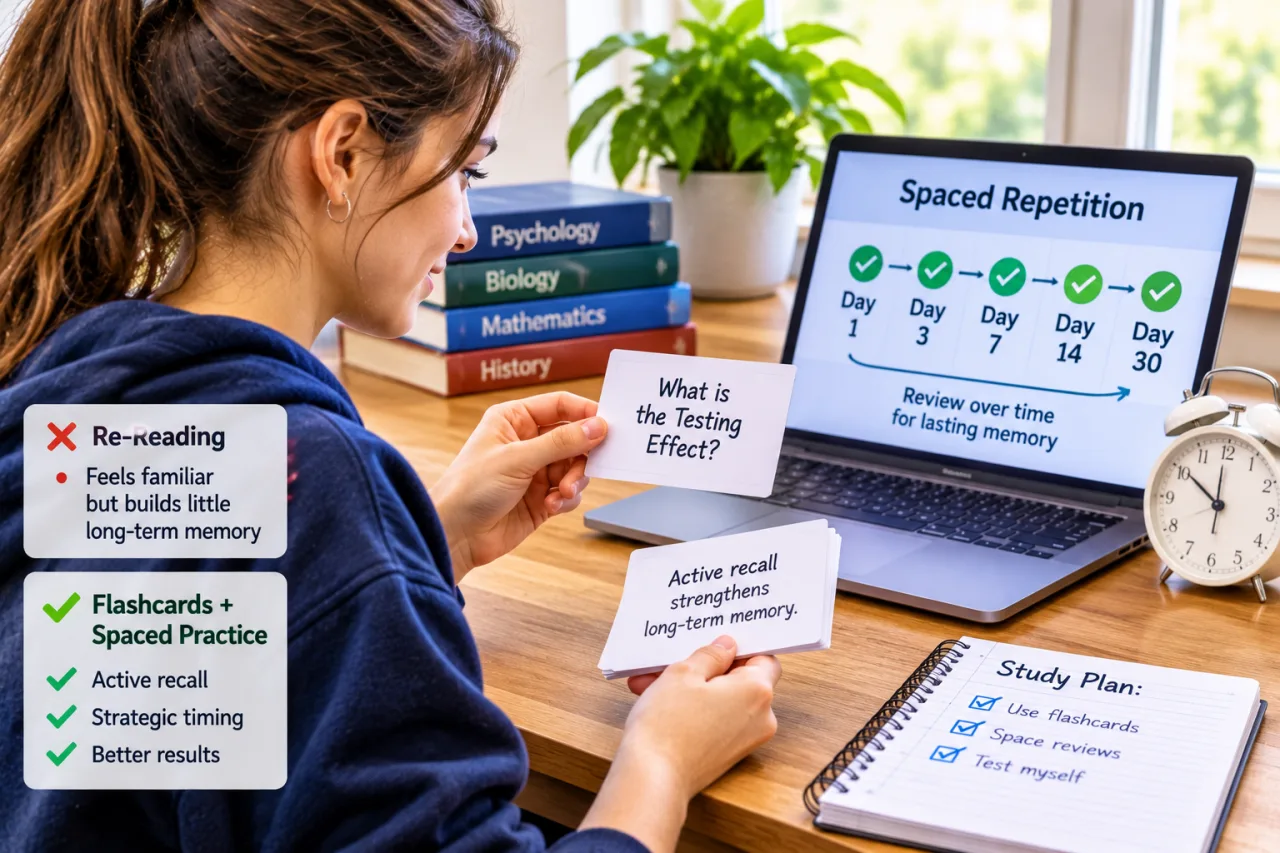
When used together, these strategies can improve long-term retention and help students identify knowledge gaps before an examination. Flashcards offer a practical way to apply both techniques, especially when combined with problem-solving, explanation, and broader subject review.
Comparing Common Study Methods
| Learning method | How it works | Main advantage | Potential limitation | Best use |
|---|---|---|---|---|
| Re-reading | Reviewing previously studied material | Refreshes familiarity and supports initial understanding | Can create a false impression of mastery if used alone | Reviewing difficult explanations and introducing topics |
| Summarization | Condensing information into shorter notes | Helps organize and connect important ideas | Can become passive copying without meaningful processing | Organizing chapters and identifying key concepts |
| Active recall | Retrieving information without immediately looking at the answer | Helps strengthen accessible knowledge and reveal gaps | Requires effort and accurate feedback | Definitions, formulas, concepts, and factual knowledge |
| Spaced practice | Reviewing information across separate sessions | Supports longer-term retention | Requires consistent planning and follow-through | Cumulative examinations and long-term learning |
1. Understanding Storage Strength and Retrieval Strength
Cognitive psychologists Robert and Elizabeth Bjork developed the New Theory of Disuse, which distinguishes between two aspects of memory: storage strength and retrieval strength.
These concepts help explain why information can feel familiar during revision but still be difficult to remember during an examination.
Storage strength describes how well information is established in memory and how strongly it is connected to other knowledge. Learning experiences and meaningful connections can contribute to stronger storage.
Retrieval strength describes how accessible information is at a particular moment. It can change depending on how recently the material was studied, the cues available, and how often the learner has successfully retrieved it.
The illusion of competence
Repeatedly reading the same notes can make information feel increasingly familiar. However, recognizing an answer while looking at the page is not the same as recalling it without assistance.
For example, a student may recognize the definition of photosynthesis immediately when reading a biology textbook. But when asked to explain photosynthesis without looking at the page, the student may struggle to remember the details.
This difference highlights an important distinction: familiarity does not necessarily mean mastery.
A useful way to check understanding is to close the textbook and try to explain the concept from memory. Any missing details can then be reviewed and corrected.
2. The Testing Effect: Why Active Recall Helps Learning
The testing effect refers to the finding that retrieving information from memory can improve later retention compared with spending the same amount of time simply restudying the material.
Active recall turns revision into an exercise in remembering rather than recognizing.
Flashcards are one practical way to use this approach.
For example:
-
Question: What is the main function of mitochondria?
-
Recall attempt: Answer without looking at the reverse side.
-
Feedback: Check the correct explanation.
-
Follow-up: Identify any missing details and try again later.
Benefits of active recall
Identifies knowledge gaps: Students discover which concepts they can explain confidently and which ones still need attention.
Encourages independent retrieval: Recalling information without immediately looking at the answer helps prepare students for examination conditions.
Provides useful feedback: Comparing an attempted answer with the correct explanation helps identify misunderstandings and incomplete knowledge.
Supports stronger retention: Repeated retrieval practice can improve the likelihood that learned information will be remembered later.
An important point is that retrieval attempts should be followed by feedback when answers are incorrect or incomplete. Simply guessing repeatedly without correcting misunderstandings is not an effective revision strategy.
3. The Spacing Effect: Why Study Sessions Should Be Distributed
The spacing effect describes the advantage of distributing learning and revision over time rather than concentrating everything into one session.
A student who studies a topic for several shorter sessions across multiple days may retain it better than someone who spends the same total time reviewing it in one uninterrupted session.
This is one reason that cramming can be less effective for long-term retention.
A practical spaced-revision schedule
Students can begin with a simple schedule such as:
| Review session | Suggested timing | Main activity |
|---|---|---|
| Initial study | Day 0 | Learn the topic and create study questions |
| First review | Day 1 | Test basic recall |
| Second review | Day 3 | Review difficult questions and correct errors |
| Third review | Day 7 | Test understanding without notes |
| Fourth review | Day 14 | Revisit challenging concepts |
| Fifth review | Day 30 | Check longer-term retention |
These intervals are examples, not scientifically fixed requirements. The best schedule depends on how difficult the material is, how well the student remembers it, and when the knowledge will be needed.
Why spacing works
Allows time between learning sessions: Returning to material after a gap requires learners to retrieve information rather than simply repeat what they have just read.
Creates opportunities to correct mistakes: Each review helps identify details that were forgotten or misunderstood.
Supports long-term learning: Revisiting information over time can make it more accessible when it is needed later.
Students should adjust the intervals based on their performance. Material that is difficult to remember may need to be reviewed sooner, while material recalled confidently can be revisited after a longer interval.
Sleep also plays an important role in memory consolidation. Regular study sessions separated by normal sleep periods provide opportunities for the brain to process and stabilize newly learned information.
4. Practical Implementation: The Leitner Box and Digital Flashcards
Students do not need complicated software to begin using spaced repetition. A simple paper-based system can work effectively.
The Leitner five-box system
The Leitner system organizes flashcards into groups according to how successfully the learner recalls the answers.
A sample five-box arrangement might work as follows:
| Box | Suggested review frequency | Card movement |
|---|---|---|
| Box 1 | Daily | New cards and cards answered incorrectly |
| Box 2 | Every 3 days | Cards answered correctly in Box 1 |
| Box 3 | Every 7 days | Cards answered correctly in Box 2 |
| Box 4 | Every 14 days | Cards answered correctly in Box 3 |
| Box 5 | Every 30 days | Cards answered correctly in Box 4 |
The review intervals can be adjusted to suit the student’s schedule.
The promotion rule: When a student answers a card correctly, it moves to the next box.
The demotion rule: When a student answers incorrectly, the card returns to an earlier box, often Box 1.
This system gives more attention to difficult material while reducing the frequency of reviewing cards that are consistently recalled correctly.
Digital spaced-repetition tools
Digital flashcard applications can automate much of the scheduling process. Some use algorithms that estimate how well a learner remembers each card and recommend when it should be reviewed again.
One well-known example is the SuperMemo SM-2 algorithm, which uses a learner’s assessment of recall quality to help calculate future review intervals.
When using digital tools, students should:
-
Create clear questions with specific answers.
-
Avoid putting too much information on one card.
-
Rate their recall honestly.
-
Review incorrect answers before moving on.
-
Edit confusing or outdated cards.
-
Avoid creating more cards than they can realistically review.
The goal is not to collect hundreds of flashcards. It is to build a manageable collection that supports meaningful learning.
5. Combining Flashcards with Deeper Understanding
Although flashcards are useful for remembering specific information, they should not replace every other learning activity.
Some subjects require students to understand relationships, evaluate evidence, solve problems, and explain complex processes. Memorizing isolated facts is not enough to develop these abilities.
Avoid excessive information fragmentation
Flashcards work particularly well for:
-
Scientific terminology.
-
Historical dates and events.
-
Foreign-language vocabulary.
-
Mathematical definitions and formulas.
-
Anatomical structures.
-
Important legal principles.
However, students should also study how these individual pieces of information connect.
For example, memorizing the definition of photosynthesis is useful, but understanding how light energy, carbon dioxide, water, and glucose relate to the process requires a broader explanation.
Use elaborative questioning
After recalling an answer, ask additional questions:
-
Why does this concept work?
-
How does it relate to another topic?
-
What would happen if one condition changed?
-
Can I explain this idea using an example?
-
How would I apply this knowledge to a new problem?
These questions encourage deeper understanding rather than simple memorization.
Practice different problem types
Interleaving involves mixing different topics or types of problems within a study session rather than practicing only one type repeatedly.
For example, a mathematics student might alternate between algebra, geometry, and probability questions.
This approach encourages learners to recognize which method or concept is appropriate for each problem. It can be particularly useful when examinations require students to choose between different problem-solving strategies.
6. Building a Balanced Revision Routine
A successful revision plan does not have to eliminate reading, note-taking, or summarization. Instead, students can combine these activities with active recall and spaced practice.
A simple study session could follow this sequence:
-
Understand: Read the lesson and identify the main concepts.
-
Organize: Write a short summary or create a concept map.
-
Retrieve: Close the materials and answer questions from memory.
-
Check: Compare answers with reliable notes or textbooks.
-
Correct: Review incomplete or incorrect answers.
-
Schedule: Decide when the material should be reviewed again.
-
Apply: Solve practice problems or explain the concept in your own words.
Students should also consider the examination format. Multiple-choice tests, essays, oral examinations, and practical assessments require different forms of preparation. Flashcards can support factual recall, but they should be supplemented with the types of practice that match the actual assessment.
Conclusion
Flashcards and spaced practice offer practical ways to make revision more active, structured, and effective. Rather than repeatedly looking at familiar information, students are encouraged to retrieve what they have learned, identify gaps, and revisit challenging material over time.
Re-reading still has a place in learning, particularly when introducing unfamiliar topics or clarifying difficult explanations. However, it is more effective when combined with retrieval practice, feedback, problem-solving, and distributed review.
By using a balanced revision routine, students can move beyond the feeling of familiarity and develop knowledge they can explain, apply, and remember when it matters.