
 admin
Have you ever watched your child glaze over during a worksheet, then light up while building a blanket fort? That contrast highlights an essential truth about child development: children retain what they actively do far better than what they merely hear.
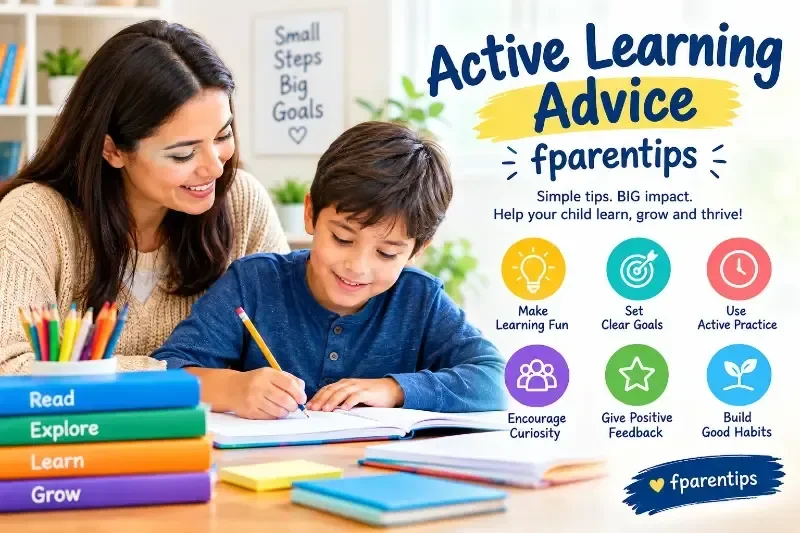
This guide provides practical active learning strategies families can implement immediately without specialized classroom equipment or teaching credentials. Below, you will find age-tailored activities, question scripts, a manageable weekly routine, and common pitfalls to avoid.
Key Takeaways
-
Engaged Minds: Active learning means your child thinks, executes, and explains rather than passively listening.
-
Bite-Sized Sessions: Start with 10 to 15 minutes each day to prevent mental fatigue.
-
Inquiry-Driven: Ask open questions rather than immediately supplying answers.
-
Process Praise: Celebrate effort, strategy, and perseverance rather than just correct answers.
-
Developmental Fit: Adapt tasks to your child’s current stage and genuine interests.
What Is Active Learning?
Active learning centers on learning through direct experience. Children ask questions, test hypotheses, construct objects, explain their reasoning, and correct errors in real time. Passive learning focuses on listening, copying, and rote memorization.
Both approaches serve a purpose, but shifting daily activities toward active engagement encourages children to take ownership of their thinking.
| Learning Focus | Passive Approach | Active Learning Alternative |
| Reading Comprehension | Highlighting sentences in a chapter | Retelling the narrative in their own words or drawing the scene |
| Math Operations | Memorizing flashcards repeatedly | Playing board or dice games that require mental arithmetic |
| Scientific Concepts | Watching an online educational video | Predicting outcomes and testing them with simple kitchen items |
| Vocabulary & Spelling | Copying spelling lists repeatedly | Writing humorous sentences or short stories using target words |
Why Hands-On Learning Works
Modern cognitive research consistently supports experiential learning methods:
-
Retrieval Practice Strengthens Memory: Cognitive research indicates that active retrieval—prompting a child to recall and explain concepts from memory—creates substantially stronger neural pathways than re-reading notes.
-
Engagement Reduces Academic Struggle: Studies comparing lecture-based instruction to interactive problem-solving show that active participation markedly improves conceptual comprehension and retention.
-
Play Develops Executive Function: The American Academy of Pediatrics emphasizes that guided play enhances language acquisition, emotional regulation, and collaborative problem-solving skills.
-
The Optimal Challenge Zone: Educational psychologist Lev Vygotsky identified the “zone of proximal development”—the instructional sweet spot where an activity challenges a child just enough to foster growth while remaining achievable with gentle scaffolding.
Five Core Rules for Effective Guidance
-
Leverage Natural Curiosity: Anchor activities to subjects your child already enjoys, whether dinosaurs, athletics, culinary arts, or astronomy.
-
Define Clear Mini-Goals: Specific prompts like “Find three textured leaves in the garden” yield better focus than open-ended instructions like “Go explore.”
-
Encourage Productive Struggle: Resilience develops when children navigate mild obstacles. Provide strategic hints rather than solving the problem for them.
-
Practice the Three-Second Pause: Pausing for at least three seconds after asking a question gives children time to process thoughts and produce deeper responses.
-
Debrief the Process: Conclude tasks with two reflective prompts: “What strategy worked best?” and “What would you adjust next time?”
Everyday Activities Categorized by Age Group
Ages 2 to 4: Touch, Sort, and Converse
-
Color and Size Sorting: Have your toddler group clean laundry by color or match pairs of socks to build classification skills.
-
Water Volume Exploration: Use measuring cups, funnels, and spoons during bath time to introduce early cause-and-effect concepts.
-
Step Counting: Count staircase steps aloud during daily walks to reinforce basic number sequencing.
-
Sensory “I Spy”: Play shape-focused guessing games (e.g., “I spy something rectangular”) to expand observation and descriptive vocabulary.
Ages 5 to 8: Measure, Retell, and Predict
-
Kitchen Math: Invite your child to double or halve simple pancake recipes to explore fractions and volume.
-
Budget-Friendly Grocery Tasks: Provide a small fixed allowance and a short shopping list to practice addition and comparative decision-making.
-
Visual Story Summaries: After finishing a book, encourage your child to illustrate their favorite scene and explain the plot arc.
-
Botanical Growth Journals: Sprout a bean seed in a cup, recording daily height measurements on a wall chart.
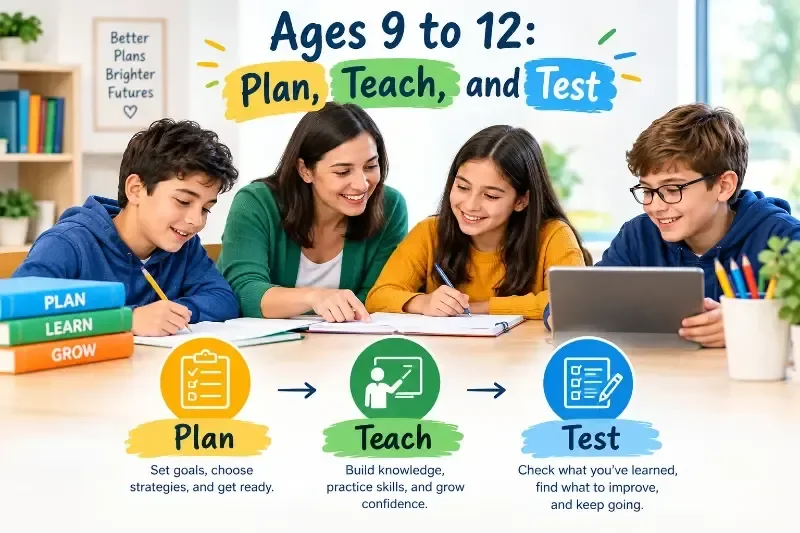
Ages 9 to 12: Plan, Teach, and Test
-
The “Teach-Back” Method: Have your child teach you a school topic as if you were the student, answering your deliberate questions.
-
Family Meal Planning: Task your pre-teen with planning a complete family dinner within a designated budget, including the ingredient checklist.
-
Hypothesis Testing: Design paper airplanes with varying wing folds, measuring flight distance to practice aerodynamic hypotheses.
-
Friendly Debate: Choose lighthearted household topics (e.g., “Should we adopt a second pet?”) and encourage structured, evidence-based arguments.
Question Prompts That Stimulate Critical Thinking
Replacing closed prompts with open-ended inquiries prompts deeper cognitive processing:
-
Instead of: “Is that correct?” $rightarrow$ Try: “What led you to that conclusion?”
-
Instead of: “Do you understand?” $rightarrow$ Try: “Can you walk me through your steps?”
-
Instead of stepping in with the solution $rightarrow$ Try: “How could we verify that answer together?”
-
Instead of: “Great job!” $rightarrow$ Try: “What was the most challenging step, and how did you resolve it?”
A Manageable 15-Minute Weekly Routine
Consistency produces sustainable results. This lightweight schedule integrates effortlessly into busy family routines:
-
Monday: Discuss an open inquiry question over dinner (e.g., “Why do shadows shift length throughout the afternoon?”).
-
Tuesday (Kitchen Math): Involve your child in measuring ingredients or dividing portions evenly.
-
Wednesday (Reading Reflection): Read a story together and ask your child to summarize the resolution in three sentences.
-
Thursday (Creative Build): Construct a simple physical model or diagram related to a recent school lesson.
-
Friday (Teach-Back Session): Let your child present one fascinating fact or concept they encountered during the week.
-
Weekend (Nature Exploration): Take a short neighborhood observation walk to identify leaf shapes or urban wildlife patterns.
Frequent Pitfalls to Avoid
-
Intervening Prematurely: Step back and allow your child time to formulate hypotheses before stepping in with guidance.
-
Over-Interrogation: Avoid rapid-fire questioning that resembles an exam; maintain a tone of shared curiosity.
-
Overextending Duration: Conclude the session while energy remains high rather than pushing toward exhaustion.
-
Focusing Exclusively on Outcomes: Prioritize perseverance and creative problem-solving over mechanical accuracy.
-
Purchasing Expensive Kits: Simple household materials, cardboard, and sketchpads regularly foster more creativity than costly packaged kits.
Frequently Asked Questions
How long should an active learning session run?
Aim for 5 to 10 minutes for toddlers (ages 2–4), 10 to 20 minutes for early elementary children (ages 5–8), and up to 30 minutes for older children. End the session early if engagement wanes.
Do I need specialized materials?
No. Standard household utensils, library books, outdoor environments, and recycled materials provide ample tools for rich experiential learning.
Can active learning replace formal homework?
Active learning serves as a complement to classroom curricula rather than a substitute. It anchors abstract classroom lessons to tangible, memorable everyday experiences.
Leave a Reply
Your email address will not be published. Required fields are marked *